Part 1 (in order)
1,1,1,1,2,3,5,8,9,10,14
Part 2 (pH)
Initial: 1
Final:7
Excercise
1(i) hydrochloric acid and sodium hydroxide
answer: hydrochloric acid + sodium hydroxide --> sodium chloride + water
(ii) hydrochloric acid and copper(II) oxide
answer: hydrochloric acid + copper(II) oxide --> copper(II) chloride + water
2) 13, 13, end, point, neutralistaion
3) increases, decreases
4(i) pH = 14
(ii) pH = 7
Done by Group 1
Terence Han,
Joseph Tan
Ng Kee Hsien
Wesley Chai
Monday, March 28, 2011

Wednesday, February 9, 2011
Yeo Feng Rui
The compound that i have chosen is Acetic Acid. Its symbol is CH3COOH. It is an organic acid that gives vinegar its sour taste and pungent smell. It is a weak acid, in that it is only a partially dissociated acid in an aqueous solution. Pure, water-free acetic acid (glacial acetic acid) is a colourless liquid that absorbs water from the environment (hygroscopy), and freezes at 16.5 °C (62 °F) to a colourless crystalline solid. The pure acid and its concentrated solutions are very corrosive.
Carbon
Carbon is the chemical element with symbol C and atomic number 6. As a member of group 14 on the periodic table, it is nonmetallic and tetravalent—making four electrons available to form covalent chemical bonds. There are three naturally occurring isotopes, with 12C and 13C being stable, while 14C is radioactive, decaying with a half-life of about 5730 years.
Hydrogen
Hydrogen is the chemical element with atomic number 1. It is represented by the symbol H. With an average atomic weight of 1.00794 u, hydrogen is the lightest and most abundant chemical element, constituting roughly 75 % of the Universe's chemical elemental mass. It is highly flammable and ignites instantly when in contact with heat. It is colourless, odourless, nonmetallic and tasteless at room temperature.
Oxygen
Oxygen is the element with atomic number 8 and represented by the symbol O. Its name derives from the Greek roots ὀξύς (oxys) (acid, literally "sharp", referring to the sour taste of acids) and -γενής (-genēs) (producer, literally begetter), because at the time of naming, it was mistakenly thought that all acids required oxygen in their composition. At standard temperature and pressure, two atoms of the element bind to form dioxygen, a colorless, odorless, tasteless diatomic gas with the formula O2.

Carbon
Carbon is the chemical element with symbol C and atomic number 6. As a member of group 14 on the periodic table, it is nonmetallic and tetravalent—making four electrons available to form covalent chemical bonds. There are three naturally occurring isotopes, with 12C and 13C being stable, while 14C is radioactive, decaying with a half-life of about 5730 years.
Hydrogen
Hydrogen is the chemical element with atomic number 1. It is represented by the symbol H. With an average atomic weight of 1.00794 u, hydrogen is the lightest and most abundant chemical element, constituting roughly 75 % of the Universe's chemical elemental mass. It is highly flammable and ignites instantly when in contact with heat. It is colourless, odourless, nonmetallic and tasteless at room temperature.
Oxygen
Oxygen is the element with atomic number 8 and represented by the symbol O. Its name derives from the Greek roots ὀξύς (oxys) (acid, literally "sharp", referring to the sour taste of acids) and -γενής (-genēs) (producer, literally begetter), because at the time of naming, it was mistakenly thought that all acids required oxygen in their composition. At standard temperature and pressure, two atoms of the element bind to form dioxygen, a colorless, odorless, tasteless diatomic gas with the formula O2.

Eric Seow (8)
Sulfur Trioxide is the chemical compound with the formula SO3. It is the primary agent of acid rain.
Formation
Sulfur Trioxide- 3 Oxygen atoms + 1 Sulfur atom
In terms of electron-counting formalisms, the three oxygen atoms are in the -2 oxidation state and the sulfur atom has an oxidation state of +6, a formal charge of 0, and is surrounded by 6 electron pairs.
Constituent Elements
The most important use of oxygen is for breathing. Animals require oxygen in their air (or water) to live.
Another use for oxygen is for oxidation reactions -- the most obvious
example is burning.  Fires require oxygen to burn.
Bonding Sulfur trioxide is formed from a covalent bond. Dot and cross diagram 
Sun Yu Hsiang (25)
The harmful compound that I chose is Cobalt Oxide. It is made up of 1 cobalt atom (Co) and 1 oxygen atom (O). Its atomic symbol is CoO. These 2 elements bond using ionic bonding. Cobalt is a harmless metal, while oxygen is a harmless gas. However, Cobalt Oxide is dangerous to humans and harmful to the environment.
Dot-and-Cross Diagram:
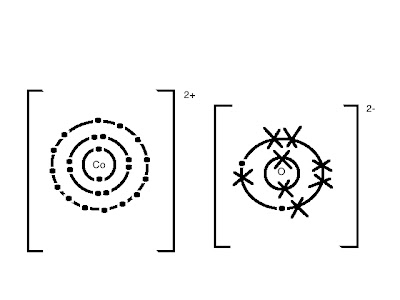
Dot-and-Cross Diagram:

Declan Lee

Nitrogen dioxide
Nitrogen dioxide is the chemical compound with the formula NO2. One of several nitrogen oxides, NO2 is an intermediate in the industrial synthesis of nitric acid, millions of tons of which are produced each year. This reddish-brown toxic gas has a characteristic sharp, biting odor and is a prominent air pollutant. Nitrogen dioxide is a paramagnetic bent molecule with C2v point group symmetry.
covalent bond

covalent bond

Joseph Tan :)
Hydrogen Bromide is the diatomic molecule HBr. HBr is a gas at standard conditions. Hydrobromic acid forms upon dissolving HBr in water. Conversely, HBr can be liberated from hydrobromic acid solutions with the addition of a dehydration agent, but not by distillation.
At room temperature, HBr is a nonflammable gas with an acrid odor, fuming in moist air because of the formation of hydrobromic acid. HBr is very soluble in water, forming hydrobromic acid solution, which is saturated at 68.85%. Aqueous solutions that are 47.38% HBr by weight form a constant-boiling mixture that boils at 126°C.
There are many uses of HBr in chemical synthesis. For example, HBr is used for the production of alkyl bromides from alcohols.
Hydrogen is an element with an atomic number of 1. It is the lightest and most abundant chemical element. Bromine has an atomic number of 35 and an atomic mass of 79.904.


Subscribe to:
Posts (Atom)